$$
\frac{1}{1-z} = 1 + z + z^2 + z^3 \dots \\
\int \frac{1}{1-z}dz = \frac{z}{1} + \frac{z^2}{2} + \frac{z^3}{3} \dots = \sum_{k=1}^{\infty} \frac{z}{k} z^k = -\ln(1-z)\\
\\
H_n = \sum_{k=1}^{n} \frac{1}{k} \hspace{0.5in} \mbox{By definition, also notice they are partial sums}\\
\rightarrow \mbox{O.G.F of $H_n$ is}\hspace{0.02in} \frac{1}{1-z}\times (-\ln(1-z)) = \frac{1}{1-z}\ln(\frac{1}{1-z}) \hspace{0.5in}\mbox{from our previous result on partial sums}\\
\rightarrow \frac{1}{1-z}\ln(\frac{1}{1-z}) = H_1\times z + H_2\times z^2 + H_3\times z^3 \ldots \hspace{0.5in} \mbox{(1)}\\
\rightarrow \frac{d}{dz}(\frac{1}{1-z}\ln(\frac{1}{1-z})) = \frac{1}{(1-z)^2}\ln(\frac{1}{1-z}) + \frac{1}{(1-z)^2} = H_1 + 2H_2\times z + 3H_3\times z^2 \ldots \hspace{0.5in}\mbox{(2)}\\
\mbox{Notice that}\hspace{0.02in} \frac{1}{(1-z)^2} = 1 + 2z + 3z^2 \dots \hspace{0.5in} \mbox{(3)}\\
\rightarrow\mbox{(2) - (3)} = \frac{1}{(1-z)^2}\ln(\frac{1}{(1-z)}) = (H_1-1) + (2H_2-2)\times z + (3H_3 -3) \times z^2 \ldots \\
\rightarrow \frac{1}{(1-z)^2}\ln(\frac{1}{(1-z)}) \hspace{0.02in} \mbox{is the O.G.F of sequence} \hspace{0.02in} (n+1)H_{n+1} - (n+1) = (n+1)(H_{n+1}-1) \hspace{0.5in} \mbox{(4)}\\
\\
\mbox{Applying the result of the partial sums to (1) the O.G.F of sequence}\hspace{0.02in} \sum_{k=1}^{n} H_n \hspace{0.02in} \mbox{is} \hspace{0.02in} \frac{1}{(1-z)}\times {\frac{1}{(1-z)}\ln(\frac{1}{1-z})} = \frac{1}{(1-z)^2}\ln(\frac{1}{(1-z)}) \hspace{0.5in} \mbox{(5)}\\
\mbox{From (4) and (5) the generating functions of both the sequences are same, hence the corresponding terms must be the same}
$$
Saturday, September 21, 2013
Simple proof for the O.G.F of partial sums
Let $A(z)$ be the O.G.F of the sequence $S = \{a_0, a_1, a_2 \ldots \}$, then we can derive the O.G.F of the sequence $b_n = \sum_{i=0}^{n} a_i$ (i.e. $B = \{a_0, a_0+a_1, a_0+a_1+a_2 \ldots \}$) as follows.
Consider the sequence $S^1 = \{0 , a_0, a_1, a_2, a_3 \ldots \}$ then O.G.F corresponding to $S^1$ is $0\times z^0 + a_0 \times z + a_1 \times z^2 + a_2 \times z^3 \ldots = z\times A(z)$. Similarly the O.G.F corresponding to the sequence $S^2 = \{0, 0, a_0, a_1, a_3 \ldots \}$ is $z^2 \times A(z)$. Now notice that if we add corresponding terms in the sequences $S^1 , S^2, S^3 \ldots$ then this
results in the sequence $B$. Hence the generating function corresponding to $B$ is $A(z) + z\times A(z) + z^2\times A(z) + z^3\times A(z) \ldots = A(z)\times(1 + z + z^2 + z^3 \ldots) = \frac{A(z)}{1-z}$ $\Box$.
Sunday, June 09, 2013
An iterative method to compute the integer linear combination of Greatest Common Divisor
Euclid's iterative method to compute the GCD is very well known. You might have also heard that $GCD(a,b)$ can be expressed as integer linear combination of $a,b$ (i.e. $GCD(a,b) = \alpha\times a + \beta \times b \,\, \alpha,\beta \in \mathcal{I}$). The following is an iterative method -- I wrote on a flight between AUS -> DFW just for fun -- which computes this integer linear combination. Runs in $O(\log(\max\{a,b\}))$ time.
The following are some examples $GCD(a,b) = (\alpha)*a + (\beta)*b$.
templatestatic inline Unit gcd_integer_linear_combination(const Unit& a, const Unit& b, Unit& alpha, Unit& beta ){ Unit divd = a, divs = b, remd=0, quot; Unit a_divd[2] = {1,0}; //linear combination of the divident// Unit a_divs[2] = {0,1}, temp[2] = {0,0}; //linear combination of the divisor// bool b_flip = false; if(divd < divs){ divd = b; divs = a; b_flip = true; } //Invariant's: divd = a_divd[0]*a + a_divd[1]*b // // divs = a_divs[0]*a + a_divs[1]*b // while(divs){ remd = divd%divs; quot = (divd-remd)/divs; divd = divs; divs = remd; temp[0] = a_divs[0]; temp[1] = a_divs[1]; a_divs[0] = a_divd[0] - (quot * a_divs[0]); a_divs[1] = a_divd[1] - (quot * a_divs[1]); a_divd[0] = temp[0]; a_divd[1] = temp[1]; } if(!b_flip){ alpha = a_divd[0]; beta = a_divd[1]; }else{ alpha = a_divd[1]; beta = a_divd[0]; } return divd; }
The following are some examples $GCD(a,b) = (\alpha)*a + (\beta)*b$.
PASSED: 2 = (1613)*42 + (-8)*8468
PASSED: 1 = (-1684)*6335 + (1641)*6501
PASSED: 5 = (344)*9170 + (-551)*5725
PASSED: 1 = (-1949)*1479 + (308)*9359
PASSED: 1 = (967)*6963 + (-1508)*4465
PASSED: 2 = (858)*5706 + (-601)*8146
PASSED: 6 = (181)*3282 + (-87)*6828
PASSED: 2 = (121)*9962 + (-2450)*492
PASSED: 1 = (-596)*2996 + (919)*1943
PASSED: 1 = (-2348)*4828 + (2085)*5437
PASSED: 1 = (283)*2392 + (-147)*4605
PASSED: 1 = (-61)*3903 + (1546)*154
PASSED: 1 = (122)*293 + (-15)*2383
PASSED: 1 = (-1528)*7422 + (1301)*8717
PASSED: 1 = (615)*9719 + (-604)*9896
PASSED: 1 = (-304)*5448 + (959)*1727
PASSED: 1 = (-139)*4772 + (431)*1539
PASSED: 1 = (493)*1870 + (-93)*9913
PASSED: 4 = (628)*5668 + (-565)*6300
PASSED: 1 = (3461)*7036 + (-2461)*9895
PASSED: 4 = (-60)*8704 + (137)*3812
PASSED: 1 = (77)*1323 + (-305)*334
PASSED: 3 = (662)*7674 + (-1089)*4665
PASSED: 2 = (3)*5142 + (-2)*7712
PASSED: 1 = (1840)*8254 + (-2211)*6869
PASSED: 1 = (2027)*5548 + (-1471)*7645
PASSED: 1 = (929)*2663 + (-897)*2758
PASSED: 2 = (-301)*38 + (4)*2860
PASSED: 2 = (-823)*8724 + (737)*9742
PASSED: 1 = (-3)*7530 + (29)*779
PASSED: 1 = (-1499)*2317 + (1144)*3036
PASSED: 1 = (662)*2191 + (-787)*1843
PASSED: 1 = (10)*289 + (-27)*107
PASSED: 1 = (4289)*9041 + (-4336)*8943
Friday, October 05, 2012
Friday fun with a dynamic program.
Its been almost an year I wrote my personal blog. I missed so many fun things I used to do as student. Well I'm a pursuit of relentless improvement. Today I just wanted to write a dynamic program -- which I have missed for a while -- so I randomly pick one of the hardest DIV-1 problems and got the dynamic program working. This is a very interesting dynamic program -- a two level one. You can read the problem -- because I cannot' post here-- from this link http://community.topcoder.com/stat?c=problem_statement&pm=1996&rd=4710 . Following is my code which passed all the 88 system tests.
Have fun -- because you can afford it only on a Friday.
Vamsi.
/* * Solution to problem: http://community.topcoder.com/stat?c=problem_statement&pm=1996&rd=4710 (SRM-178, DIV-1, hard) * * Vamsi K. Kundeti 10/05/2012 * **/ #include#include #include #include #include using namespace std; #define MAX_ROWS 50 #define MAX_STROKES 3000 class MinPaint { private: /*Optimal number of mismatches to color a row 'i' till 'j' with a *stoke ending black using 'k' strokes : 'm_aB[j%2][i][k]' */ size_t m_aB[2][MAX_ROWS][MAX_STROKES]; size_t m_aW[2][MAX_ROWS][MAX_STROKES]; /*Optimal number of mismatches in the image upto row 'i' using 'k' *strokes*/ int m_aOPT[2][3001]; //optimal value is stored in m_aB[0][i][j] vector m_aImg; public: MinPaint(): m_aB(), m_aW(), m_aImg() {} void initRow(size_t idx, size_t maxStrokes){ for(size_t j=0; j<=maxStrokes; j++){ m_aB[0][idx][j] = !j ? 1 : m_aImg[idx][0] == 'W'; m_aW[0][idx][j] = !j ? 1 : m_aImg[idx][0] == 'B'; } } size_t findMin(size_t a, size_t b){ return a < b ? a : b; } void dynamicProgramPerRow(size_t idx, size_t maxStrokes){ initRow(idx, maxStrokes); for(size_t i=1; i < m_aImg[idx].size(); i++){ for(size_t j=0; j <= maxStrokes; j++){ if(m_aImg[idx][i] == 'W'){ m_aW[i%2][idx][j] = !j ? i+1 : findMin(m_aW[(i-1)%2][idx][j], m_aB[(i-1)%2][idx][j-1]); m_aB[i%2][idx][j] = !j ? i+1 : findMin(m_aB[(i-1)%2][idx][j]+1, m_aW[(i-1)%2][idx][j-1]+1); }else{ m_aB[i%2][idx][j] = !j ? i+1 : findMin(m_aB[(i-1)%2][idx][j], m_aW[(i-1)%2][idx][j-1]); m_aW[i%2][idx][j] = !j ? i+1 : findMin(m_aW[(i-1)%2][idx][j]+1, m_aB[(i-1)%2][idx][j-1]+1); } } } //choose the min between m_aB and m_aW size_t nidx = m_aImg[idx].size()-1; for(size_t i=0; i<=maxStrokes; i++){ m_aB[nidx%2][idx][i] = findMin(m_aB[nidx%2][idx][i], m_aW[nidx%2][idx][i]); } } int leastBad(const vector &Img, const int &maxStrokes){ m_aImg = Img; for(size_t i=0; i< Img.size(); i++){ dynamicProgramPerRow(i, (size_t)maxStrokes); } //now find the optimal across rows// for(int i=0; i<=maxStrokes; i++){ m_aOPT[0][i] = m_aB[(Img[0].size()-1)%2][0][i]; } for(size_t j=1; j<Img.size(); j++){ /*choose number of strokes from [1, maxStrokes-j] to paint row 'j'*/ size_t rsize_idx = m_aImg[j].size()-1; for(int usedStrokes=0; usedStrokes<=maxStrokes; usedStrokes++){ int min = numeric_limits ::max(); int current_min; int min_k=0; for(int k=0; k<=usedStrokes; k++){ //use 'k' strokes to color current row 'j' and 'usedStrokes-j' for the //array below 'j'. current_min = m_aOPT[(j-1)%2][usedStrokes-k] + (m_aB[(rsize_idx)%2][j][k]); if(current_min < min){ min = current_min; min_k = k; } } m_aOPT[j%2][usedStrokes] = min; } } return m_aOPT[(Img.size()-1)%2][maxStrokes]; } size_t OptPerRow(size_t idx, size_t maxStrokes){ return m_aB[(m_aImg[idx].size()-1)%2][idx][maxStrokes-1]; } }; /*INPUT FILE FORMAT: * * * X Y * string1 * string2 * ... * ... * ... * stringX * *X is the number of rows *Y is the maximum number of strokes **/ int main(int argc, char **argv){ char buf[4096]; vector input; size_t imgSize, maxStrokes; MinPaint X; while(scanf("%lu%lu", &imgSize, &maxStrokes)==2){ input.clear(); while(imgSize-- && scanf("%s", &buf) == 1){ input.push_back(string(buf)); } int opt = X.leastBad(input, maxStrokes); printf("%d\n", opt); } }
Have fun -- because you can afford it only on a Friday.
Vamsi.
Saturday, May 14, 2011
[TECH] Enumerating set partitions with $DLX$
I have been a great fan of Dr. Knuth's paper about Dancing Links (Algorithm X) . In that paper Don suggests how the combinatorial search using backtracking can be improved in practice with the original idea from Hitotumatu and Noshita. One strange thing about Dancing Links is that its not Don's original idea, however Don made it popular by writing a paper about it. Don used the $DLX$ idea to solve the exact cover (matrix cover) problem and he gave several examples (e.g. Covering an rectilinear area with Pentominos) where he certain combinatorial problems to exact cover.
I have been waiting to find a problem where I get to apply $DLX$ without reducing it to exact cover problem. I'm really happy now that simultaneous hamming neighborhood problem (given a set $S=\{s_1,s_2\ldots s_n\},\, s_i\in \Sigma^{l}$ of strings compute the set $N_d(S) = \{ t | hamming(s_i,t)\leq d ,\forall s_i \in S\}$) which I have been working lately can be solved by applying $DLX$. As I mentioned in my earlier post the algorithm to compute $N_d(S)$ needs solve a set partition problem -- which further needs an algorithm to enumerate all the subsets of a given size $r$. In my previous post we have seen how to compute $n \choose r$ efficiently with backtracking. I'm now going use $DLX$ to solve the same problem. Notice that $DLX$ is an overkill to this simple problem, however it really makes sense if we look it from the perspective of the partitioning problem -- which is what we want to solve. $DLX$ just plays the role of UNDO operation see below.
/*Implementation of $n \choose r$ using $DLX$*/
enum_count_t EnumSubSetsCountDLX(size_t n, size_t r){
 enum_count_t n_choose_r=0;
 DLXState *dlx_sentinal = GetEnumSubSetsDLXState(n); /*Initialize the DLXState*/
 DLXState *sidx_dat[r+1], **state_idx=sidx_dat; /*item picked in the state*/
 /*total # of items picked in a given state*/
 size_t scidx_dat[r+1], *state_count_idx=scidx_dat;
 size_t level;

 state_count_idx--; state_idx--; /*1-indexing*/
 level=1; state_count_idx[level]=0; state_idx[level] = dlx_sentinal;
 while(level){
  if(level == r+1){
   n_choose_r++;
   level--;
   if(level) Dance(state_idx[level]);
  }else if(state_count_idx[level]+r-level > n-1){ /*state_idx[level]*/
   level--;
   if(level) Dance(state_idx[level]);
  }else{
   state_idx[level] = state_idx[level]->right;
   Break(state_idx[level]);
   state_count_idx[level]++;
   /*track forward*/
   state_count_idx[level+1] = state_count_idx[level];
   state_idx[level+1] = state_idx[level];
   level++;
  }
 }
 CleanDLXState(dlx_sentinal); /*cleanup*/
 return n_choose_r;
}

/*Break and Dance operations*/
void Break(DLXState *state){
 state->left->right = state->right;
 state->right->left = state->left;
}
void Dance(DLXState *state){
 state->left->right = state;
 state->right->left = state;
}

/*Initializes a new DLX state required to enumerate $n \choose r$*/
EnumSubSetState* GetNewEnumSStateWithDLX(DLXState *dlx_sentinal,
 size_t n, size_t r){

 EnumSubSetState *estate = malloc(sizeof(EnumSubSetState));
 assert(estate);
 estate->dlx_sentinal = dlx_sentinal;

 estate->state_count_idx = malloc(sizeof(size_t)*(r+1));
 estate->state_idx = malloc(sizeof(DLXState *)*(r+1));
 assert(estate->state_count_idx && estate->state_idx);

 (estate->state_count_idx)--; (estate->state_idx)--;

 estate->level=1; estate->state_count_idx[1]=0;
 estate->state_idx[1] = estate->dlx_sentinal;
 estate->n = n; estate->r = r;
 return estate;

}
Next I'll post the most interesting part which is to enumerate the partitions using $DLX$.
Friday, May 06, 2011
[TECH] Enumerating subsets with backtracking and some interesting observations on the backtracking enumeration tree.
During my current research on enumerating all the common Hamming neighborhood of a set of strings. I needed an algorithm which can enumerate seven disjoint subsets from a given set. The fundamental building block in that is an algorithm which enumerates all the subsets of size $r$ from a given set of size $n$. I'm very much aware of the standard recursive algorithm which uses the fact ${n \choose r} = {n-1 \choose r} + {n-1 \choose r-1}$. However I wanted a much efficient version because I need to use this several times and cannot afford the constants in stack based implementations. So I wrote the following to backtracking based algorithm to enumerate the subsets. Once I did that I started observing some very interesting patterns in the number of leaves for each internal backtrack node at level $r-1$.
/*Back tracking*/
enum_count_t EnumSubSetsPrint(char *set, size_t n, size_t r){
    size_t state_idx_data[r+1], i, level;
    size_t *state_idx = state_idx_data;
    enum_count_t n_choose_r=0;

    set--;
    state_idx--;
    for(i=1; i<=r+1; i++){ /*initialize*/
        state_idx[i] = 0;
    }

    level = 1;
    while(level){
        if(level == r+1){
            /*back track*/
            for(i=1; i<=r; i++){
                printf("%c ", set[state_idx[i]]);
            }
            printf("\n");
            n_choose_r++;
            level--;
        }else if(state_idx[level]+r-level > n-1){
            level--;
        }else{
            /*track forward*/
            state_idx[level]++; /*pick a item*/
            state_idx[level+1] = state_idx[level];
            level++;
        }
    }
    return n_choose_r;
}
By looking at these patterns (at the end of this paragraph) I came up with the following interesting identities for $n \choose 3$ and $n \choose 4$.
I'm actually printing the number of leaves under an internal node at level $r-1$ in the backtracking tree. I'm observing the following pattern.
=================
8 3 0

6 5 4 3 2 1
5 4 3 2 1
4 3 2 1
3 2 1
2 1
1
(8 \choose 3) = 56

Please enter n and r < n and print_option
 (e.g. 15 14 1 or 15 14 0)
9 3 0

7 6 5 4 3 2 1
6 5 4 3 2 1
5 4 3 2 1
4 3 2 1
3 2 1
2 1
1
(9 \choose 3) = 84

Please enter n and r < n and print_option
 (e.g. 15 14 1 or 15 14 0)
10 3 0

8 7 6 5 4 3 2 1
7 6 5 4 3 2 1
6 5 4 3 2 1
5 4 3 2 1
4 3 2 1
3 2 1
2 1
1
(10 \choose 3) = 120
Please enter n and r < n and print_option
 (e.g. 15 14 1 or 15 14 0)
11 3 0

9 8 7 6 5 4 3 2 1
8 7 6 5 4 3 2 1
7 6 5 4 3 2 1
6 5 4 3 2 1
5 4 3 2 1
4 3 2 1
3 2 1
2 1
1
===============================

The following are for $n \choose 4$ for various values of $n$.
===============================
8 4 0

5 4 3 2 1
4 3 2 1
3 2 1
2 1
1
4 3 2 1
3 2 1
2 1
1
3 2 1
2 1
1
2 1
1
1
(8 \choose 4) = 70

Please enter n and r < n and print_option
 (e.g. 15 14 1 or 15 14 0)
9 4 0

6 5 4 3 2 1
5 4 3 2 1
4 3 2 1
3 2 1
2 1
1
5 4 3 2 1
4 3 2 1
3 2 1
2 1
1
4 3 2 1
3 2 1
2 1
1
3 2 1
2 1
1
2 1
1
1

===============================
Play around with this program Enumerate.c , Enumerate.h.
Finally I enabled $LaTeX$ setting for the blog.
Thursday, May 05, 2011
[THEORY] Is nature a giant guessing algorithm ?
I was reading Dr. Lipton's blog on guessing and was really impressed on how he relates the power of guessing with the question whether P=NP or P!=NP.
Looks like nature on the other had seems to be solving several combinatorial problems almost instantly (e.g. folding of the proteins to minimize its energy), does nature guess the solution to the problem ?. One way to guess a solution to a problem is to look inside the building blocks which formulated the problem. Dr. Lipton gives an example were we were supposed to guess the digits which can open a lock -- the lock we normally use in the GYM. It may be hard to guess the digits which can open a lock without any help. However if we can get an X-ray of the levers we can guess the solution to the problem more easily. So does this mean nature looks at the problems in a totally different perspective ? , is there something very intuitive to the nature which the humans fail to recognize ?.
Why did all the great mathematicians failed to find a polynomial solution 3-SAT ? -- or prove it does not exist. Is there something missing in the way we are looking at a digital circuit ? , can we design guessing algorithms to solve the NP-Complete problems ?. We don't know the answers for all these. But I'm sure that nature is a great guessing algorithm and it may be impossible for us to guess its guessing algorithm.
Tuesday, April 12, 2011
[TECH] Unbuffered message logging of interactive programs.
We generally use one of the following methods to log the output messages of programs which print a lot of messages.
-
$ ./program >& message.log
-
$ ./program |& tee message.log
One obvious way to fix this is to put fflush(stdout) after every printf statement you have, this is OK for small programs but for very large programs its really tedious. I came up with the following technique to solve this problem. This solution is generic.
[main.c]

int main(int argc, char **argv){

 ForceLogMessages("message.log");
 ....
 ...
}

void ForceLogMessages(const char *mesg_file){
    int ret_setvbuf;
    /*close the stdout and re-open a text file*/
    fclose(stdout);
    stdout = fopen(name, "w");
    //make stdout unbuffered
    ret_setvbuf = setvbuf(stdout, (char *) NULL, _IOLBF, 0);
    if(ret_setvbuf){
        fprintf(stderr, "UNABLE TO MAKE stdout UNBUFFERED %s", strerror(errno));
    }
    assert(stdout);
}
Now if we run the program and we can monitor the status with tail -f message.log since we have made stdout unbuffered we can see a message in message.log every time a printf is executed in the original program and you can know what exactly is happening.
Thursday, March 24, 2011
[TECH] juggernaut-asm: An out-of-core sequence assembler
Development updates on the juggernaut-asm project.I'm now branching off the trunk to implement the feature which avoids using the UNIX sort. To checkout the main branch as follows. This is the version of the code I used to obtain the results on 4million reads which the in-memory algorithm of Velvet could not handle.
cvs -d:pserver:anonymous@juggernaut-asm.cvs.sourceforge.net:/cvsroot/juggernaut-asm co .
The code to replace the unix sort being developed in the branch name 'replace-unix-sort'.
cvs -d:ext:vamsi99@juggernaut-asm.cvs.sourceforge.net:/cvsroot/juggernaut-asm co -r replace-unix-sort .
Wednesday, March 23, 2011
[TECH] External R-Way Merge sorting.
http://lib-ex-sort.sourceforge.net/ is an external sorting program the following are the limitations I wish to remove before I leave in May. Most of them are engineering changes but are very useful for several algorithms based on external sorting.
- Currently the size of each key is a constant. We need to remove this by adding a key_header for each key.
- Use MMAP for integer sorting to avoid copy between user and kernel space.
- Support for sorting when the data spans multiple files.
Friday, August 27, 2010
[TECH] Combinatorial counting under symmetries with Polya's Theorem
Recently I have started looking at the problem of enumerating Graphs. During my journey I was thrilled at the beauty of Polya's theorem. After applying the theorem on several examples I felt that I should write an article which explains the context and need for Polya's theorem.
This is the first blog I'm writing after taking a break over the summer. I had few things which had happened to me recently. I'm going to talk about them some other time as they are more philosophical.
Friday, April 09, 2010
[TECH] Super-fast tokenizing of sequence word patterns
#!/bin/perl
#
# AHO-CORASICK-TOKENIZER on words, will also work on any delemiter.
# INPUT(1): Set of patterns (sequence of words) 'P'
# INPUT(2): Text 'T'
# OUTPUT: report all the occuring patterns -- we don't even
# want to know their locations.
#
# NOTE: We don't want to worry much about the time required to
# construct the failure function. All we need is to improve the
# scan speed.
#
# PATTERN FILE FORMAT:
# <annotation> $$$ pattern
#
# vamsik@engr.uconn.edu 04/08/2010
#

($#ARGV == 1) or die("USAGE: perl <name> pattern_file text_file");

open(PATTERN_FILE, $ARGV[0]) or die($!);

open(TEXT_FILE, $ARGV[1]) or die($!);
%AC_TREE;
%PATTERN_HASH;

$ANNOT_DELIM = ";;a;;";
$FAILED_DELIM = ";;f;;";
$HEIGHT_DELIM = ";;h;;"; #to move within the text

sub BuildKwordTree{

# root of the Aho-Corasick tree #
	my @params = @_;
	my $ac_root = $params[0];

	my $PFILE = $params[1];
	my ($line, $pword_list, $pattern, $curr_node, $pword);


	while(<$PFILE>){
		$line = $_; chomp($line);

		if($line =~ /([^\$]+)\$\$\$ (.*)/){
			$annotation = $1;

			$pattern = $2;
# split the pattern into words delimited by any #
# non-newline character. #
			@pword_list = split(/\s+/, $pattern);

			$curr_node = $ac_root;
			foreach $pword (@pword_list){
				${$curr_node}{$pword} =
					{} unless exists ${$curr_node}{$pword};

				$curr_node = ${$curr_node}{$pword};
			}
# put-the annotation into the last-node of the key-word tree
			${$curr_node}{$ANNOT_DELIM} = $annotation;
		}
	}
}

#
# Build the failure function level-by level
#
#
sub BuildFailureFunction{
	my @params = @_;
	my $ac_root = $params[0];

	my ($k, @bfs_list, $keyword);
#
# Incremental algorithm; For level-1 its the $ac_root itself
#
	${$ac_root}{$FAILED_DELIM} = $ac_root;

	${$ac_root}{$HEIGHT_DELIM} = 0;
	foreach $k (keys %$ac_root){

		if(($k eq $FAILED_DELIM) or ($k eq $ANNOT_DELIM)
			or ($k eq $HEIGHT_DELIM)){

			next;
		}
		${${$ac_root}{$k}}{$FAILED_DELIM} =  $ac_root;

		${${$ac_root}{$k}}{$HEIGHT_DELIM} = 1;
		push(@bfs_list, ${$ac_root}{$k});
	}


	while($#bfs_list >= 0){
		$nref = shift(@bfs_list); #node

		foreach $keyword (keys %$nref){

			if(($keyword eq $FAILED_DELIM) or
					($keyword eq $ANNOT_DELIM) or
					($keyword eq $HEIGHT_DELIM)){

				next;
			}

			$nnref = ${$nref}{$keyword};

			$fpref = ${$nref}{$FAILED_DELIM};
			while(!(exists ${$fpref}{$keyword})

				and $fpref != $ac_root){
				$fpref = ${$fpref}{$FAILED_DELIM};
			}

			if(exists ${$fpref}{$keyword}){
				${$nnref}{$FAILED_DELIM} = ${$fpref}{$keyword};
			}else{

				${$nnref}{$FAILED_DELIM} = $ac_root;
			}
			${$nnref}{$HEIGHT_DELIM} = ${$nref}{$HEIGHT_DELIM}+1;

			push(@bfs_list, $nnref);
		}
	}
}
#
# Reads word delimited text from the stream or a file
#
sub MatchWordDelimText{
	my @params = @_;

	my $ac_root = $params[0];
	my $stream = $params[1];

	my ($curr_state, $annot, $sword, $c, $height);

	my $line;

	while(<$stream>){
		$line = $_; chomp($line);

		$curr_state = $ac_root;
		@swords = split(/\s+/, $_);

		$c = 0;
		while($c <= $#swords){

			$sword = $swords[$c];
# Change the state of the automaton by reading the input
#			print "I:$sword C:$c 1:$curr_state ";
			if(exists ${$curr_state}{$sword}){

				$curr_state = ${$curr_state}{$sword};
				$c++;
			}else{

				if($curr_state == $ac_root){
					$c++;
				}
				$curr_state = ${$curr_state}{$FAILED_DELIM};
			}

#			print "2:$curr_state \n";
			if(exists ${$curr_state}{$ANNOT_DELIM}){
				$annot = ${$curr_state}{$ANNOT_DELIM};

				print "$annot \n";
			}
		}
	}
}

sub StressTestMatchWordDelimText{
	my @params = @_;

	my $ac_root = $params[0];
	my $stream = $params[1];

	my ($curr_state, $annot, $sword, $c, $height);

	my $line;
	my ($stress_me, $ss);
	$line = <$stream>;

	print "ABSTRACT: $line\n";
	chomp($line);
	$stress_me = 1000000;

	for($s=0; $s< $stress_me; $s++){
		if($s%100000 == 0){

			print "iteration $s \n";
		}
		$curr_state = $ac_root;
		@swords = split(/\s+/, $_);

		$c = 0;
		while($c <= $#swords){

			$sword = $swords[$c];
# Change the state of the automaton by reading the input
#			print "I:$sword C:$c 1:$curr_state ";
			if(exists ${$curr_state}{$sword}){

				$curr_state = ${$curr_state}{$sword};
				$c++;
			}else{

				if($curr_state == $ac_root){
					$c++;
				}
				$curr_state = ${$curr_state}{$FAILED_DELIM};
			}

#			print "2:$curr_state \n";
			if(exists ${$curr_state}{$ANNOT_DELIM}){
				$annot = ${$curr_state}{$ANNOT_DELIM};

#				print "$annot \n";
			}
		}
	}
}

#
# Just to see how the tree looks -- for viewing pleasure :)
#
sub PrintKwordTree{
	my @params = @_;

	my $ac_root = $params[0];
	my $level = $params[1];

	my ($k, $aref, $annot, $j, $nref, $fref, $height);

	foreach $k (keys %$ac_root){
		if(($k eq $ANNOT_DELIM)
			or ($k eq $FAILED_DELIM) or ($k eq $HEIGHT_DELIM)){

			next;
		}
		for($j=0; $j<$level; $j++){

			print " ";
		}
		$fref = ${${$ac_root}{$k}}{$FAILED_DELIM};

		$nref = ${$ac_root}{$k};
		$height = ${$nref}{$HEIGHT_DELIM};

		print "-$k-> N=$nref F=$fref h=$height\n";
		PrintKwordTree(${$ac_root}{$k}, $level+1);
	}


	if(exists ${$ac_root}{$ANNOT_DELIM}){
		$annot = ${$ac_root}{$ANNOT_DELIM};

		for($j=0; $j<$level; $j++){
			print " ";
		}

		print "; $annot ;\n\n";
		return;
	}
}
#
# A simple unit-test
#
sub main{
	BuildKwordTree(\%AC_TREE, PATTERN_FILE);

#	PrintKwordTree(\%AC_TREE, 0);
	BuildFailureFunction(\%AC_TREE);
#	PrintKwordTree(\%AC_TREE, 0);
# Now build the failure function.
	print "please enter the words\n";
#	MatchWordDelimText(\%AC_TREE, STDIN);
	StressTestMatchWordDelimText(\%AC_TREE, TEXT_FILE);

	print "\n....THANK YOU......\n";
}
main();
Thursday, March 11, 2010
[PHIL] My best lines in "The zen and art of motor cycle maintenance"
We often read a lot. On the other hand we also tend to forget most of what we read. However the essence/flavor/curx what ever you might call may still persist. Some time if were asked to recall about something -- say a novel for example. Then some very distinctively marked paragraphs would normally on top of your head. So whenever I think about "The zen and the art of motorcycle maintenance" the following few paragraphs are always on my mind. You can read the full book here
In time...six months; five years, perhaps...a change could easily begin to take place. He would become less and less satisfied with a kind of dumb, day-to-day shopwork. His creative intelligence, stifled by too much theory and too many grades in college, would now become reawakened by the boredom of the shop. Thousands of hours of frustrating mechanical problems would have made him more interested in machine design. He would like to design machinery himself. He’d think he could do a better job. He would try modifying a few engines, meet with success, look for more success, but feel blocked because he didn’t have the theoretical information. He would discover that when before he felt stupid because of his lack of interest in theoretical information, he’d now find a brand of theoretical information which he’d have a lot of respect for, namely, mechanical engineering.
So he would come back to our degreeless and gradeless school, but with a difference. He’d no longer be a grade-motivated person. He’d be a knowledge-motivated person. He would need no external pushing to learn. His push would come from inside. He’d be a free man. He wouldn’t need a lot of discipline to shape him up. In fact, if the instructors assigned him were slacking on the job he would be likely to shape them up by asking rude questions. He’d be there to learn something, would be paying to learn something and they’d better come up with it.
Motivation of this sort, once it catches hold, is a ferocious force, and in the gradeless, degreeless institution where our student would find himself, he wouldn’t stop with rote engineering information. Physics and mathematics were going to come within his sphere of interest because he’d see he needed them. Metallurgy and electrical engineering would come up for attention. And, in the process of intellectual maturing that these abstract studies gave him, he would he likely to branch out into other theoretical areas that weren’t directly related to machines but had become a part of a newer larger goal. This larger goal wouldn’t be the imitation of education in Universities today, glossed over and concealed by grades and degrees that give the appearance of something happening when, in fact, almost nothing is going on. It would be the real thing.
Wednesday, March 10, 2010
[TECH] Tutte matrix and Sufficiency of Perfect Matching.
I know that this is a standard results. But a hands on proof is really useful because it makes things more clear. I knew the fact that any permutation could be broken into disjoint cycles. However I did not know how the sign of the permutation changes if we swap the elements with in a disjoint cycle. It turns out that some of the fundamental properties of the signs of the permutation can be used to prove the sufficiency of a perfect matching in graph. A Tutte Matrix is defined as follows.
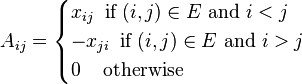
Given a Tutte matrix we now prove the sufficiency of perfect matching
Determinant of Tutte matrix is as follows .
We know that every permutation can be expressed as disjoint cycles. For example permutation
 can be expressed as two cycles
 .
Also
 is the number of swaps we need do required to convert
 to the permutation
 .
We observe the following important properties which help solve the problem.
- PROPERTY-1 If
 is a cycle
in then if we replace
 with reverse cycle
 then remains
the same - because we did not change the number of swaps required but just changed the order of swaps. For instance,
let
 then cycle
 now we replace
it with
 . This results in
 .
- PROPERTY-2 Let is a cycle of odd length in and let
 be the permutation
by replacing with its reverse cycle
 . Then the corresponding terms in the determinant
for and are
 and
 .
For example in the previous example
so the
corresponding term in the determinant for
 is
 . On the other hand
the reverse cycle
 has the following term
 in the determinant.
- PROPERTY-3 If all the cycles in the permutation are even and corresponding term
in the determinant (i.e.
 ) is non-zero then its the set
 is a valid perfect match in the graph. This is because by the definition of Tutte matrix
 represents an edge in the graph and the permutation is giving a subset of
 edges since
the product is non-zero, on the other than this sub-set of edges is a match.
"IF  has a perfect match THEN
 has at least one non-zero term"
Let  be the perfect match in then we construct a permutation
 where
 , this
permutation on the other hand has even cycles - because we created a cycle for every pair. Now we apply
PROPERTY-3 and the term corresponding to in is non-zero.
IF  THEN has no perfect matching
Now consider the case when does not have no perfect matching. Then by PROPERTY-3 all the terms
corresponding permutations with even cycles must be zero - otherwise our assumption leads
to contradiction. Now consider the permutations with at least one odd cycle, let
be that permutation and be the odd cycle. Now we replace with its reverse cycle and
create the permutation . By PROPERTY-1
 . Now we exploit the skew-symmetry
of the Tutte matrix. By PROPERTY-2 the terms corresponding to , in the determinant are
as follows.
 ,
 . But by skew-symmetry
 , on the other hand since the cycle length is odd this gives that the actual terms
corresponding to and are
 and
 . This means all the terms corresponding to permutations with at least one odd cycle can be grouped and pairs
such as and be cancelled. So the only contribution for the comes from permutations will all even cycles - in this
case we have none, so .
Subscribe to:
Posts (Atom)